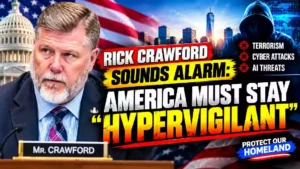
Rick Crawford Sounds Alarm on Growing US Threats: America Must Stay “Hypervigilant”

Rep. Rick Crawford warns that the United States must remain “hypervigilant” as terrorism, cyberattacks, artificial intelligence and other emerging threats challenge homeland security.
Rick Crawford Sounds Alarm on Growing US Threats: America Must Stay “Hypervigilant”
Rick Crawford Warns America Faces a New Era of Homeland Threats
The United States must remain “hypervigilant” in protecting the homeland as adversaries exploit new technologies, geopolitical tensions and vulnerabilities that did not exist in the same form after the September 11 attacks, according to House Intelligence Committee Chairman Rick Crawford.
Crawford, a Republican from Arkansas, said the security reforms implemented after 9/11 were effective, but warned that America’s national security work is far from finished. The threat landscape has changed dramatically over the past 25 years, creating a new challenge for the nation’s intelligence and security agencies.
America Cannot Afford Another “Failure of Imagination”
At the center of Crawford’s warning is a lesson from the 9/11 Commission: the danger of failing to imagine how an adversary might exploit vulnerabilities.
The United States has more information, more technology and more intelligence capabilities than it did before 9/11. But Crawford said that also means there are “exponentially more dots to connect.”
The challenge is recognizing relationships between seemingly unrelated warning signs before they develop into a serious threat.
Crawford argued that intelligence officials must constantly reevaluate their assumptions and “red team” their own security systems—essentially looking at America’s defenses from the perspective of an adversary.
“Adversaries,” he said, do not organize around the government’s bureaucracy. They organize around its vulnerabilities.
Threats Now Go Beyond Terrorism
Crawford stressed that terrorism remains an important national security concern, but America’s intelligence community must look beyond traditional terrorist threats.
He pointed to Russia, China, Iran, Cuba and North Korea as nation-state actors capable of creating threats to the United States in different ways. Counterintelligence, he said, needs renewed attention as foreign adversaries attempt to advance their interests and exploit weaknesses.
That changing environment has also been accelerated by technology.
Artificial intelligence, cyber capabilities and other emerging technologies could give hostile actors new ways to target American interests. Crawford warned that the United States needs to understand not only what adversaries can do today, but what they may be capable of doing tomorrow.
Multiple Threat Vectors Are Active
The concern becomes even greater when several threats emerge at the same time.
Crawford referenced concerns involving proxies, homegrown violent extremists, ISIS-inspired threats and Hezbollah-inspired threats. He argued that U.S. officials need to anticipate potential attacks rather than simply respond after an incident occurs.
The result is a national security environment in which terrorism, foreign intelligence operations, cyber activity and geopolitical conflicts can overlap.
That makes identifying the source of a threat increasingly complicated—and makes intelligence coordination even more important.
Iran and China Highlight the Challenge
Crawford specifically pointed to the capabilities of certain nation-state adversaries when discussing unconventional threats.
He described Iran as aggressive in the cyber arena, while warning that China possesses significant capabilities related to biological threats. He stressed that U.S. officials need to closely monitor nation-state capabilities because attacks could potentially target the American homeland or Americans and U.S. allies overseas.
The broader concern is that America’s adversaries may not rely on conventional military attacks.
Cyber operations, intelligence collection, terrorism through proxy groups and other asymmetric methods can potentially create serious consequences without looking like a traditional act of war.
The Iran-Terrorism Connection
Crawford also highlighted what he described as the connection between nation-state activity and terrorism.
He pointed to Iran’s relationships with groups including Hamas, Hezbollah, the Houthis and Iraqi militias, arguing that nation-state support and proxy activity can create a complicated security challenge for the United States and its allies.
For intelligence agencies, that means threats cannot always be placed neatly into separate categories.
A terrorist organization, a foreign government and a cyber operation may represent different parts of a broader security challenge.
Why “Hypervigilance” Matters
Crawford’s warning ultimately comes down to preparedness.
The reforms created after 9/11 helped address serious weaknesses in the U.S. intelligence system, but the world confronting American intelligence agencies today is different. The House Intelligence Committee’s ongoing 9/11 review is examining how the threat environment has evolved and whether existing structures are prepared for emerging challenges.
For Crawford, the answer requires constant vigilance.
The United States must identify vulnerabilities before adversaries discover them, anticipate unconventional threats and continually challenge its own assumptions.
That is why Crawford says America must be “hypervigilant” about protecting the homeland.
Twenty-five years after 9/11, the lesson is not simply that America must remember what happened. It is that national security officials must continue imagining what could happen next—and prepare before the warning signs become an attack.
#RickCrawford #HomelandSecurity #NationalSecurity #HouseIntelligenceCommittee #Counterintelligence #Terrorism #CyberSecurity #ArtificialIntelligence #Iran #China #Russia #911Commission #USSecurity