Tom Cotton Warns Foreign Funding Could Fuel Radical Movements and Deepen US Divisions
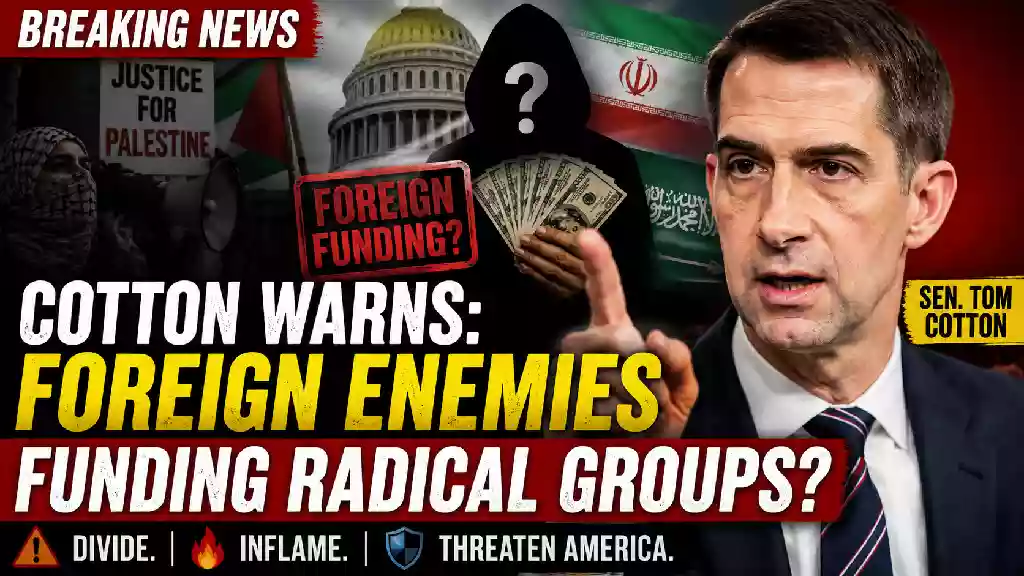
Sen. Tom Cotton raises concerns about foreign funding, radical political movements and potential foreign influence in the United States.
Tom Cotton Warns Foreign Funding Could Fuel Radical Movements and Deepen US Divisions
Senator Raises Alarm Over Foreign Influence and Domestic Extremism
Sen. Tom Cotton is warning that foreign funding and ideological movements could be contributing to political and social divisions in the United States, arguing that Americans need greater transparency about where financial support for radical organizations originates.
During a discussion about political extremism, Cotton described what he characterized as a growing fusion between Marxist or socialist ideology and radical Islamism. He argued that the trend is becoming increasingly visible in American political life, college campuses and other institutions.
Cotton’s comments come amid a broader national debate over foreign influence, political polarization, immigration enforcement and the activities of organizations accused by critics of supporting extremist agendas.
The senator argued that the issue should not be viewed simply through the lens of domestic politics. Instead, he suggested that foreign actors could have an interest in exploiting divisions within American society.
Cotton Points to Foreign Funding
One of the central themes of Cotton’s remarks was the need to investigate foreign sources of funding for organizations that he considers radical.
Cotton said Americans have a right to know whether money from foreign governments or other overseas actors is reaching groups involved in political activism inside the United States. He characterized such funding as a potential tool for foreign adversaries seeking to “divide and inflame” Americans against one another.
The senator specifically discussed organizations including the Council on American-Islamic Relations, or CAIR, and Students for Justice in Palestine. The source reflects the allegations and characterizations made during the interview; it does not independently establish that these organizations are funded by foreign enemies or that they operate as terrorist fronts.
The discussion highlights an increasingly contentious question in American politics: how should the government distinguish legitimate political activism and protected speech from activities that may involve foreign influence or support for violent extremist causes?
Immigration Enforcement Becomes Part of the Debate
Cotton also connected the issue of foreign influence to immigration enforcement.
He argued that individuals who enter the United States under false pretenses or violate immigration laws should face consequences. He further maintained that people who deliberately enter the country with the goal of promoting radical anti-American views should not be allowed to remain.
The senator’s comments reflect the continuing political battle over the role of Immigration and Customs Enforcement, commonly known as ICE. Cotton criticized Democrats who support reducing funding for the agency, arguing that ICE plays an important role in identifying and deporting individuals who violate immigration laws.
Immigration enforcement has become one of the most divisive issues in Washington, with Republicans generally emphasizing border security and deportation while Democrats and immigration advocates have raised concerns about enforcement practices, due process and the treatment of immigrants.
Political Candidates Become Part of Cotton’s Warning
Cotton also pointed to recent Democratic candidates as examples of what he described as a broader ideological shift within the party.
He referenced political contests in Michigan, Maine, New York, New Jersey and Denver, alleging that some candidates hold extreme positions on immigration, taxation, foreign policy or other issues. He argued that voters should pay close attention to candidates seeking positions in Congress because their policies could affect Americans nationwide.
The remarks underscore how political campaigns increasingly focus not only on individual candidates but also on questions about ideology, national security and the direction of the major political parties.
A Growing Debate Over Foreign Influence
Cotton’s warning comes as concerns over foreign interference and political influence continue to shape American public debate. Foreign governments and organizations have long been scrutinized for their efforts to influence U.S. politics, public opinion and policy.
However, allegations involving foreign funding or extremist connections require evidence and careful investigation. Political rhetoric alone does not establish that an organization or individual is acting on behalf of a foreign government or supporting terrorism.
For Cotton, greater transparency is an essential first step. He argued that Americans should be able to determine whether foreign money is helping finance movements that seek to intensify political conflict inside the United States.
The broader debate is likely to continue through the 2026 election cycle, particularly as immigration, national security, foreign influence and political extremism remain major issues for voters.
Ultimately, Cotton’s message is that Americans should pay close attention to the sources of political influence entering the country. His critics, meanwhile, are likely to argue that accusations involving extremist movements and foreign funding must be supported by verifiable evidence rather than political assertions.
As the election season develops, the balance between national security, immigration enforcement, free expression and legitimate political activism will remain at the center of one of the country’s most consequential political debates.
#TomCotton #SenTomCotton #ForeignFunding #ForeignInfluence #RadicalGroups #NationalSecurity #USPolitics #AmericanPolitics #PoliticalExtremism #ForeignInterference